Aiding Backstage Communication
Before a show can occur, an orchestra of communication must occur between teams in perfect harmony, Relay was conceptualized to improve it.
DURATION
10 Weeks
ROLE
Product Designer | Home Page
STATUS
College Concept
PEOPLE


AT A GLANCE
Before, during, and after a show, hundreds of workers are expected to work in unison with outdated technologies and practices. Information gets lost due to unclear or temporary communication where tools at hand are not built for friction or risk.
I acted as a product designer focusing on the home page of our digital interface called Relay. I owned this page primarily as well as shaping the visual style of the app. This was alongside 3 other designers focusing on other parts of our solution, but will focus on my contributions in this case study.
REDESIGN OUTCOMES
Adapting flows, not getting rid of them
A dashboard that changes with the team
On the home page of Relay, the dashboard showcasing relevant information also changed per the situation that the team is in. This is mainly seen in three stages, pre-show, show, and post show, and will update accordingly.

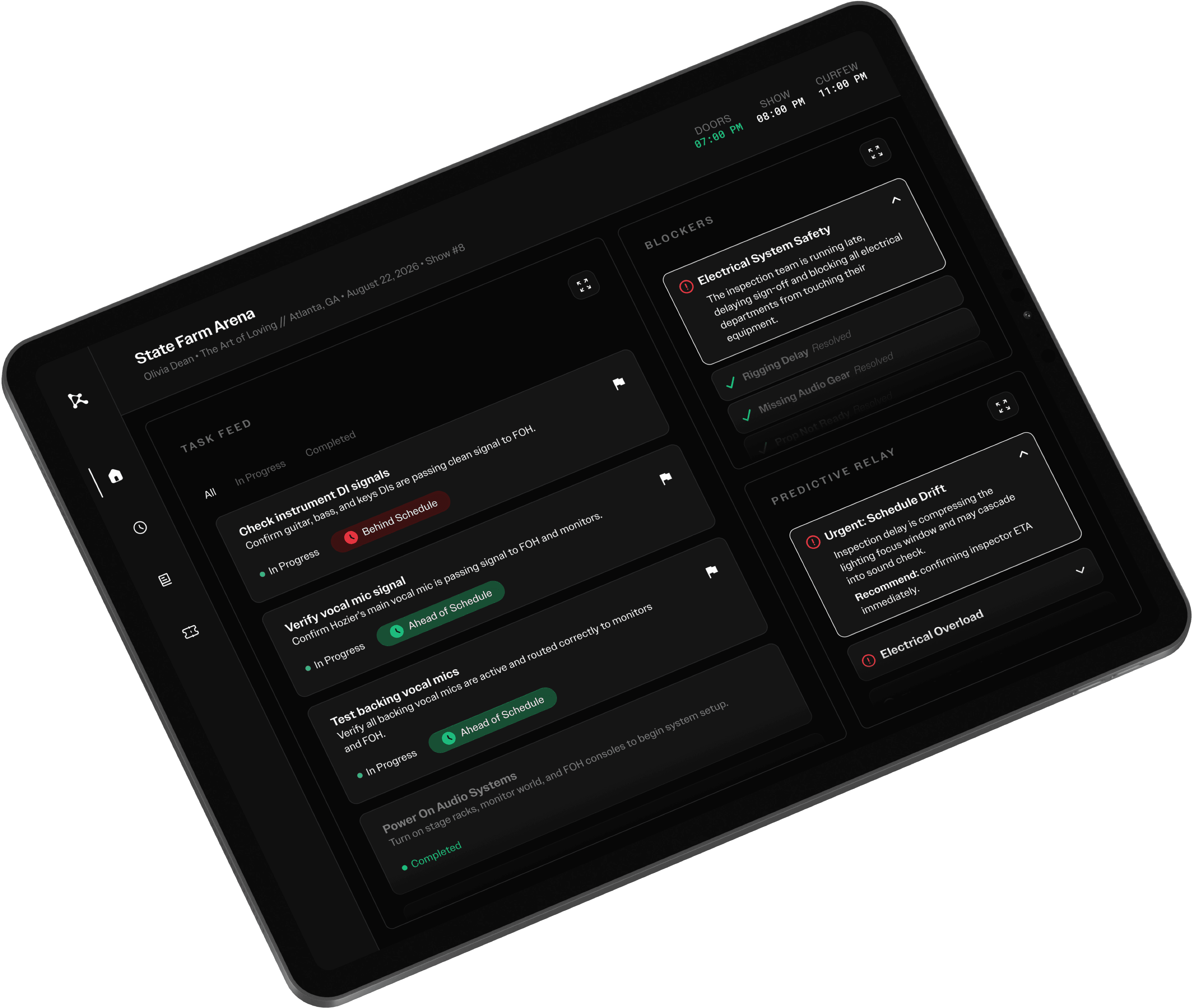
Predicting risks before they get out of Control
By harnessing AI recognition, we can give predictive risks that may occur during the entire stage process, allowing coordinators and workers to stay on top of future issues.
Live cue tracking to stay on time
Being able to track the cues during showtime without the hassle of physical paper allows for quick changes, multiple eyes, and communication all around.

AI insights that are actually helpful
By implementing AI into understanding and interpretation rather than an AI chatbot we create useful actionable insights to view.
KEY MOMENTS
Balancing the old and new
When it comes to any industry, a new product or tool to "solve" their issues comes with costs. We wanted to determine how we could help the backstage crew without taking away the culture already created, and practices that work already. We did this by focusing research on all user groups from experienced to inexperienced and varying levels of responsibility.
51 Survey Responses
Across Multiple Reddit / Facebook groups for crews
9 Interviews
With current and previous backstage workers for true stories
5 User tests
In person tests with backstage workers testing our product
IMPACT
Expected metrics to track
Being able to implement this system into backstage teams would take some time, but from what we believe teams will only benefit Relay's use. While this is a concept, we were able to get real feedback from target users showcasing their likelihood to try this product.
Amount of miscommunication throughout the show process before and after using Relay
Number of teams who continue to use Relay's products after testing
User sentiment and feedback throughout launch
REFLECTIONS
To take away into my next opportunity
This space was something I was pretty unfamiliar with, but learning more about it, I took some good things away…
Meet your users where they are
As designers that have not stepped on foot on a backstage (other than our PM). We can attempt to make decisions on what we think is best, but especially for this project we needed to figure out what works for them and how we can solve the gaps in their current ways, not to replace them.
Show the user your product, in person is even better
In school we are told to user test constantly, but with projects like these it may be hard to even grab a couple moments of time with them. But we found a moment, a stage was being setup at our school and we ACTED on it. That feedback was so useful and they loved seeing our ideas.
OTHER PROJECTS
